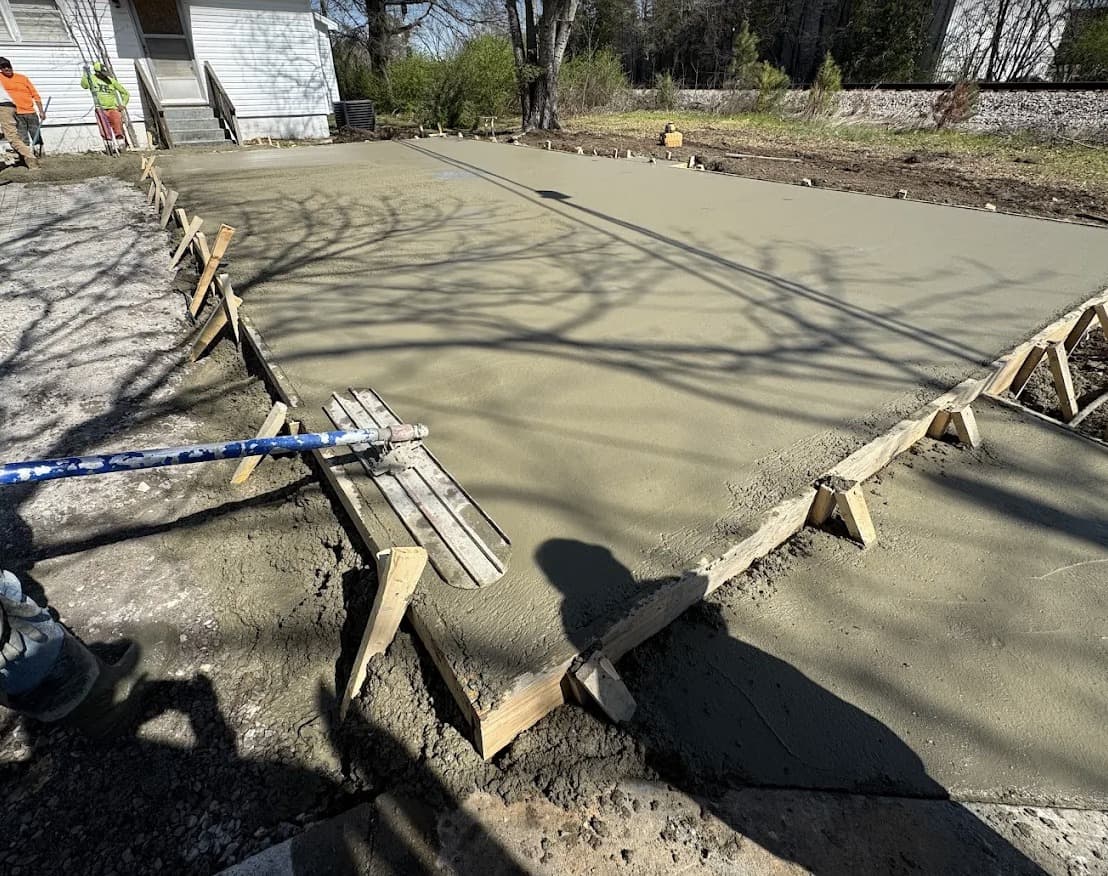
If you own a home anywhere in the Gardendale area, you've probably seen it: a driveway with a crack running corner to corner, a patio with one section that's sunk half an inch below the rest, or a sidewalk that's heaved at a joint. Concrete cracking is common enough in Alabama that a lot of homeowners assume it's just inevitable. It isn't — but understanding why it happens is the first step to actually preventing it.
It usually starts with the soil, not the concrete
North Jefferson County — Gardendale, Fultondale, Kimberly, Morris, and the surrounding communities — sits on expansive red clay. This soil type absorbs water and swells during wet periods, then shrinks and pulls away from itself during dry stretches. That expansion and contraction cycle happens every year, sometimes more than once, and it puts real mechanical stress on whatever's sitting on top of it. A concrete slab poured directly on unprepared or poorly compacted clay is essentially riding on a surface that's constantly shifting beneath it. Over enough cycles, something gives — usually in the form of a crack at the slab's weakest point.
Some cracking is normal — here's the difference
Not all cracking is a problem. As concrete cures, it shrinks slightly, and fine hairline cracks (sometimes called shrinkage cracks) are a normal part of that process. These are typically thin, don't move when you press on either side, and don't affect the slab's structural performance.
The cracking worth worrying about is different: cracks wide enough to catch a fingernail, cracks where one side sits higher than the other (a sign of settling), multiple cracks running in different directions, or cracks that keep growing year over year. That kind of damage usually points to a base or reinforcement problem, not just normal curing shrinkage.
The four real causes of problem cracking
1. Inadequate base preparation
If the subgrade under a slab isn't properly compacted — or if organic material, loose fill, or soft spots are left in place before the pour — the slab has no stable foundation to sit on. Water finds those weak points, softens them further, and the concrete above eventually cracks or settles into the gap. This is one of the most common causes we see on older driveways and patios throughout Gardendale and Center Point, especially ones poured decades ago when base prep standards were less consistent.
2. Missing or insufficient reinforcement
Steel reinforcement — rebar or wire mesh — doesn't stop concrete from cracking, but it holds the slab together at the crack so it doesn't separate, heave, or become a trip hazard. Concrete poured without adequate reinforcement, or with reinforcement placed too low or too high in the slab, loses that benefit. On North Jefferson County's clay soil, reinforcement is one of the last places a contractor should cut corners to save cost. Our driveways and foundations and slabs pages cover the reinforcement standards we build to.
3. Missing or incorrectly spaced control joints
Control joints are intentional weak points cut into a slab so that, when the concrete inevitably shrinks and cracks, it cracks along that planned line instead of randomly across the surface. If joints are spaced too far apart — or skipped altogether — the slab cracks wherever the stress happens to concentrate, which is rarely a clean, predictable line.
4. Drainage problems and tree roots
Water pooling against a slab edge, or a large tree root growing beneath a driveway or walkway, both apply uneven pressure that standard reinforcement isn't designed to fully resist. On Gardendale's rolling, hillside lots, proper grading — sloping surfaces roughly a quarter-inch per foot away from structures — is as important to crack prevention as anything happening in the concrete mix itself.
How proper installation prevents it
The fixes aren't exotic — they're fundamentals that are easy to skip if a contractor is trying to hit a low price:
- Compacted, properly graded subgrade before any concrete is placed
- Correct slab thickness for the intended use (4" standard, 5"+ for heavier loads)
- Steel reinforcement sized and positioned for the application
- Control joints cut at the right spacing for the slab thickness
- Positive drainage grading away from structures
- A quality penetrating sealer to limit moisture intrusion and freeze-thaw damage
None of these are optional extras on Alabama clay — they're the baseline for a slab that's actually built to last.
What to do if your concrete is already cracked
If you're dealing with an existing cracked or settled driveway, patio, or walkway, the first step is figuring out whether the damage is cosmetic or a sign of a deeper base or drainage problem. Minor cracking and localized settling are often good candidates for repair or resurfacing rather than full replacement, which saves significant cost when the underlying slab is still sound. Widespread cracking or a base that's failed structurally usually means replacement is the better long-term investment. We give every homeowner an honest read on which category their concrete falls into before recommending a fix.
Get an honest assessment
Whether you're building new and want it done right the first time, or you're dealing with cracking on an existing driveway or patio, we'll walk your property, explain what's actually happening, and recommend the fix that makes sense — not the most expensive one. See our full concrete services or request a free estimate anywhere in Gardendale and North Jefferson County.