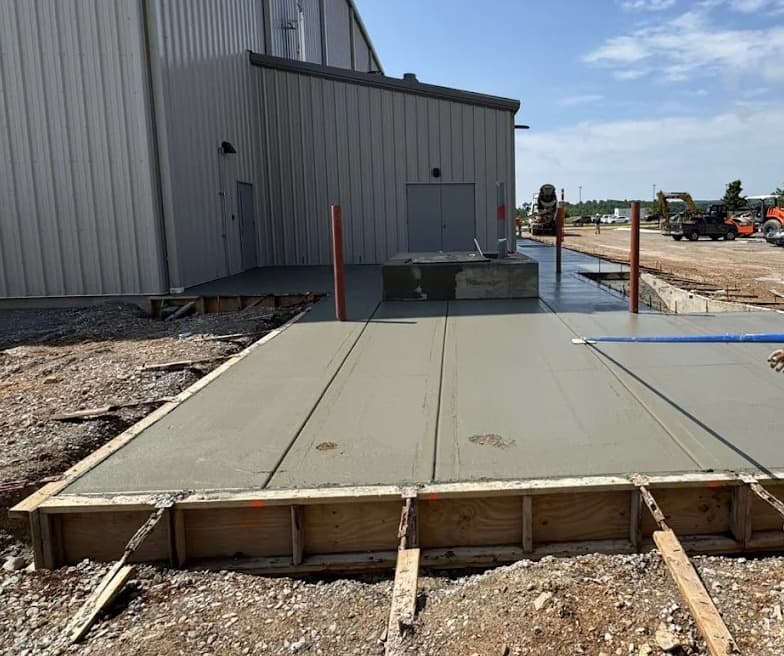
Gardendale has grown steadily along the I-65 corridor over the past several years, and that growth shows up in the number of new homes going up off Fieldstown Road, Mt. Olive Road, and the subdivisions filling in around the area. If you're building new — whether you're working directly with a builder or acting as your own general contractor on a lot in Kimberly or Morris — the concrete decisions you make (or don't make) up front determine how your driveway, garage floor, and patio hold up for the next several decades. Here's what to actually specify.
Start with the soil, not the slab
North Jefferson County sits on expansive red clay that swells when it's wet and shrinks when it's dry. That movement is the single biggest cause of cracked and heaved concrete in this area, and it's a bigger factor here than in a lot of other parts of the Birmingham metro because of how much the clay content varies from lot to lot — sometimes even across the same property. Before anything gets poured, ask whatever contractor you're working with how they're handling subgrade preparation: how the base is compacted, whether fill material is needed, and how drainage is planned around the structure. A slab poured on an under-compacted or poorly graded base will crack regardless of how thick it is or how much steel is in it.
Driveway thickness and reinforcement
A standard residential concrete drivewayshould be poured at a minimum of 4 inches for passenger vehicles. If you're planning to park trucks, trailers, or an RV — common on larger lots out toward Kimberly and Morris — specify 5 inches or more. Steel reinforcement (rebar or wire mesh) matters more on Alabama clay than it does in a lot of other regions; skipping or under-specifying it is one of the most common ways new-construction driveways end up cracking within the first few years. Ask specifically what reinforcement grid your contractor plans to use and where control joints will be cut — they should be spaced to match the slab thickness, generally around 10 feet on center for a 4-inch pour.
Garage and shop floor specs
A standard garage slab is typically 4 inches, matching the driveway. If you're planning a workshop, a heavier vehicle bay, or storage for equipment — something we see often on the larger properties around Mount Olive and Morris — specify 5 to 6 inches with additional reinforcement. It's much less expensive to build this into the original pour than to add a secondary slab or overlay later once you realize the floor can't handle the load you actually need. Our foundations and slabs page covers the reinforcement and thickness options in more detail.
Don't treat the patio as an afterthought
Builder-grade patios are frequently undersized — a small slab just big enough for a grill and two chairs. If you know you want real outdoor living space, it's worth having the conversation about patio size and finish before the framing is even up, especially if you want a stamped or decorative finish that requires more planning around color and pattern selection. Extending a small builder patio after the fact is completely doable — it's one of our most common projects — but building it right the first time saves you a second mobilization and a visible seam where old and new concrete meet.
Grading and drainage around the structure
Gardendale's rolling, hillside terrain means final grading matters as much as the concrete mix itself. Every driveway, patio, and walkway should be sloped roughly a quarter-inch per foot away from the house and any other structure, and the site as a whole should direct surface water away from the foundation. On sloped lots, this sometimes means a retaining wall is needed to hold back a cut or fill slope before other flatwork can be properly graded. If your lot has any meaningful grade change, get this addressed in the site plan rather than trying to solve it after the driveway is already poured.
Sealer isn't optional
New concrete should be sealed with a quality penetrating sealer after it cures — this protects against moisture intrusion, UV fading, and freeze-thaw damage during Alabama's winter cold snaps. It's a small cost relative to the total project and it's the kind of detail that gets skipped when a contractor is trying to hit a price point. Ask specifically whether sealer is included in your quote and what type is being used.
Questions to ask any concrete contractor before you sign
- What thickness and reinforcement do you recommend for this specific slab, and why?
- How will the subgrade be prepared and compacted?
- Where will control joints be placed, and at what spacing?
- Is a penetrating sealer included, and what type?
- How is drainage being handled around the structure?
A contractor who can answer these specifically — not with a generic one-size-fits-all answer — is one who's actually thinking about your lot and your soil, not just pouring concrete and moving to the next job.
Building in the Gardendale area?
Whether you're working with a builder or coordinating the concrete scope yourself, we're happy to walk your site and give you a straightforward assessment of what your driveway, garage slab, or patio actually needs. See our full concrete services, browse our service areas across North Jefferson County, or request a free estimate for your new construction project.